Generic selectors
Exact matches only
Search in title
Search in content
Post Type Selectors
guides
products
Filter by Categories
Anti-Snoring Reviews
Bedding
Bedding Information
Bedding Reviews
Best Bed Frames
Best Comforters
Best Mattress
Best Mattress Pads
Best Mattress Protectors
Best Mattress Toppers
Best Pillowcases
Best Pillows
Best Sheets
Interviews
Mattress Accessories
Mattress Comparisons
Mattress Coupons
Mattress Information
Mattress Reviews
Mattress Sales
Mattress Sizes
Mattress Topper Reviews
Pillow Reviews
Sheet Reviews
Sleep
Sleep Environment
Sleep Products
Sleep Tracker Reviews
Uncategorized
Weighted Blanket Reviews
Our editors test & choose the products we write about. When you buy through links on our site, we may earn a commission. Learn More.

Best Mattresses for Kids of 2026

Written by Tuck Staff

Quick Overview

Choosing the best mattress for a child depends on more than a price tag. Additional factors include age and growth stage, sleep position, budget, safety and material considerations, and whether this is their first “big kid” bed or one meant to last into the teen years.

The market doesn’t make it easier. Hundreds of mattresses are marketed for kids, but it can be difficult to tell whether a given bed is constructed with quality materials or built to support a child at different stages of growth. Parents are often left with little more to go on than vague firmness claims and product photos.

This guide takes a different approach. We combine hands-on testing with data-backed research — evaluating firmness, durability, and material safety — in order to narrow the crowded field to eight standout kids’ mattresses. There’s an option here for every age, budget, and preference, whether you’re buying for a toddler or a teen.

Best Mattresses for Kids
First Time Buying a Mattress for Your Child?

Hop down to our Buyer’s Guide for a crash course on finding the best mattress for kids.


The Best Mattresses for Kids - Reviewed

Best OverallHelix Kids

Best Overall – Helix Kids

Highlights

  • Flippable with two firmness levels (4,6)
  • 120-night sleep trial
  • Lifetime warranty
  • Waterproof cover for easy cleanup
  • Certified-safe materials throughout
Up to 30% off
Claim Discount

Best OverallHelix Kids

helixsleep.com

Shop Now

The Helix Kids earns our Best Overall pick due to its thoughtful dual-sided construction. Each surface has a different feel to offer appropriate support for growing bodies, and the liquid-repellent cover protects against spills and accidents. The mattress is a good match for early elementary kids to preteens, making it an easy recommendation for parents who want one dependable bed to carry their child through several growth stages.

Construction is where this mattress separates itself. The waterproof antimicrobial cover is a useful feature for younger sleepers, while a dual-sided design lets you flip to a firmer or softer feel as your child grows. Both sides aim for the medium firm range rather than a plush, sink-in feel in order to support spinal alignment and healthy pressure distribution for growing bodies. If your child is a hot sleeper, you can upgrade to a cool-to-the-touch cover for a small extra fee. Standard models measure 8 inches thick, but you can also opt for a 6-inch bunk-friendly design at no extra charge.

For a bed designed to last through several growth stages, the Helix Kids’ overall value is strong. Shipping is also free for customers in the contiguous U.S. Your order includes a 120-night trial, giving your kiddo plenty of time to test out the bed in their own room, as well as a lifetime warranty for added peace of mind.

The Bottom Line.

The Helix Kids is supportive, durable, and easy to clean, making it a practical choice for parents who want a single bed to accommodate their child through multiple growth stages.

  • Growing kids who need varying levels of support from their mattress as they age.
  • Budget-conscious parents looking for a mattress to serve their child from early elementary into their pre-teen years.
  • Accident-prone children who can benefit from using a bed with waterproof protection.

Not Recommended for...

  • Small children who aren’t quite ready to transition to a big kid bed.
  • Older teens who would rather sleep on an adult mattress.

Best ValueBrooklyn Bedding Kids Mattress

Best Value – Brooklyn Bedding Kids Mattress

Highlights

  • Firm (7)
  • 120-night sleep trial
  • Lifetime warranty
  • Durable, budget-friendly construction
  • Ultra-supportive to support healthy sleep posture
30% off sitewide with code: LABORDAY30
Check Price

Best ValueBrooklyn Bedding Kids Mattress

brooklynbedding.com

Shop Now

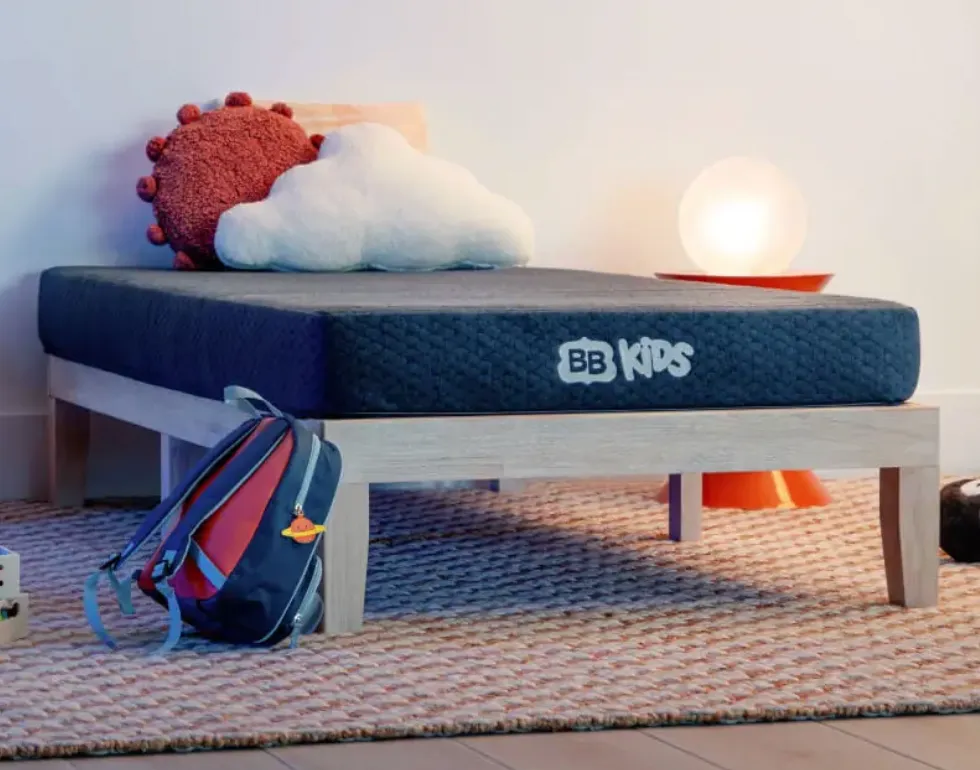
The Brooklyn Bedding BB Kids earns Best Value by delivering solid support and safe materials at a price that won’t strain a family budget. It’s proof that affordable doesn’t have to mean flimsy. This is a good match for younger kids transitioning from a crib through the elementary years, and it’s especially appealing for families outfitting a first big-kid bed without wanting to overspend on a mattress their child may soon outgrow.

The BB Kids is firm (7) and supportive to promote even pressure distribution and health alignment, which is key for your child’s overall development. The materials carry safety certifications, and the stain-repellent cover protects the mattress when spills or accidents occur. The bed also sleeps reasonably cool and holds its shape well over time.

The BB Kids ships free throughout the contiguous U.S., arrives compressed in a box, and expands within a few hours. Brooklyn Bedding backs the mattress with a 120-night sleep trial, giving families ample time to confirm it will work for their child. Your purchase also includes a lifetime warranty against various manufacturing defects.

The Bottom Line.

The BB Kids gives budget-minded families dependable support and certified materials without the premium price, making it an ideal first big-kid bed.

  • Budget-conscious parents who still want quality construction.
  • Younger kids in the early elementary years.
  • Hot sleepers who tend to feel overly warm on soft beds.

Not Recommended for:

  • Older kids and preteens who need a larger, more supportive mattress.
  • Heavier kids who could benefit from sleeping on a thicker, sturdier bed.

Best HybridBear Cub

Best Hybrid – Bear Cub

Highlights

  • Firm (7)
  • 120-night sleep trial
  • Lifetime warranty
  • Reinforced edge support
  • Surface is bouncy and easy to move on
40% off sitewide with code: SF40
Shop Now

Best HybridBear Cub

bearmattress.com

Shop Now

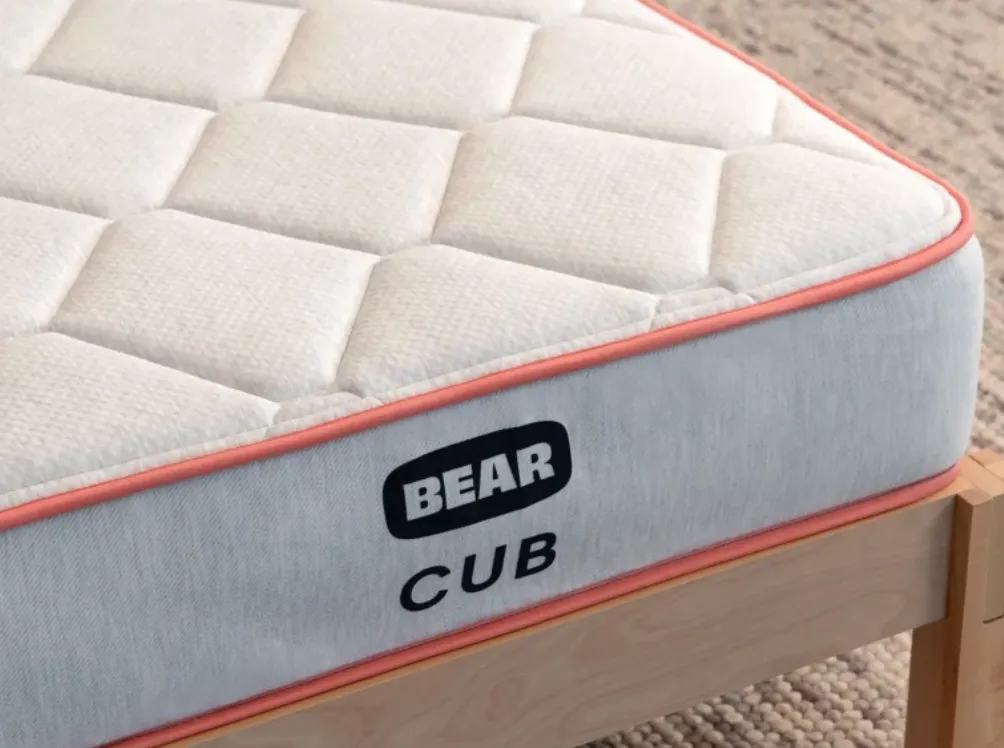
Hybrid mattresses are all the rage among adult sleepers, but kid-friendly hybrids are less common. The Bear Cub bucks this trend with a firm (7), ultra-supportive foam-over-coil design that feels springy and provides just the right amount of cushioning for growing bodies. It’s a good match for elementary age kids and older — especially those who enjoy a bouncy mattress that pushes back against them.

The Bear Cub’s coil support core delivers the bounce and reinforced edge support that keep kids feeling stable whey they’re lying or sitting near the perimeter of their bed while the foam comfort layers distribute weight to create a soothing cradle. The materials carry safety certifications, and the coils promote airflow for cooler sleep.

Bear backs the Cub with a 120-night sleep trial and a lifetime warranty. It ships free within the contiguous U.S., arrives compressed in a box, and should expand within a few hours. Your child can choose from two colors, salmon or arctic blue.

The Bottom Line.

The Bear Cub brings coil-driven bounce and strong edge support to a kids’ bed, making it a standout for kids who want or need firmer, more responsive support.

  • Active kids who want a mattress that feels bouncy or responsive.
  • Young children transitioning to their first big kid bed.
  • Budget-minded parents looking for a mattress with approachable pricing.

Not Recommended for:

  • Children with bunk beds who need a lower-profile mattress to meet current safety guidelines.
  • Parents seeking a twin XL mattress who don’t want to compromise with a different size.

Best OrganicBirch Kids Natural

Best Organic – Birch Kids Natural

Highlights

  • Flippable with two firmness levels (5,7)
  • 120-night sleep trial
  • Lifetime warranty
  • Wool layers for breathability and temperature regulation
  • Latex and coils make the surface feel bouncy
27% off with code: SF27
Claim Discount

Best OrganicBirch Kids Natural

birchliving.com

Shop Now

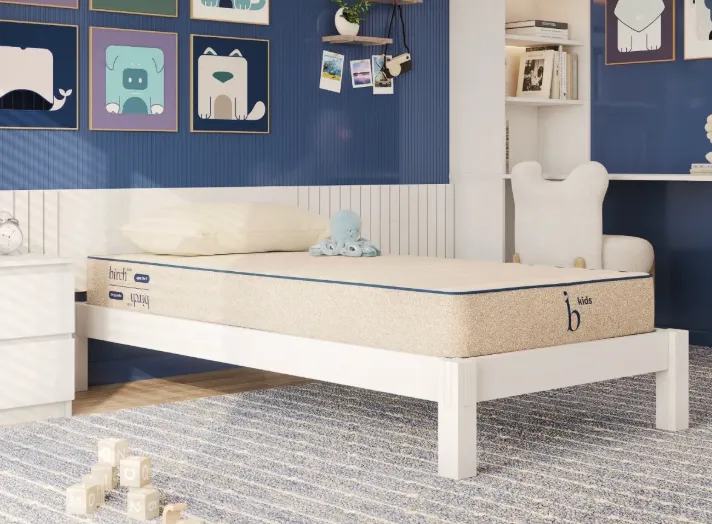
The Birch Kids Natural earns Best Organic for its focus on certified natural materials — a priority for parents who want to limit their child’s chemical exposure at bedtime. It’s a good match for kids of any age, and particularly for households that put low-emission materials near the top of their list. The natural build doesn’t sacrifice performance, which is what makes it more than a niche choice.

Rather than using synthetic materials, the reversible Birch Kids contains an organic cotton cover, natural wool fire barrier, and premium organic latex. One side is medium (5) and cushioned with latex for light contouring and gentle pushback, while the other side is firm (7) and contains less padding to make this surface feel highly responsive. This versatile construction ensures the mattress will accommodate your child from a very young age to their preteen years. One thing to keep in mind: the mattress is fairly heavy, so you should enlist the help of a lifting partner whenever it needs to be flipped.

Birch offers free ground shipping throughout the contiguous U.S., and each order includes a 120-night sleep trial. This lengthy period gives your child plenty of time to test out both sides of the bed and decide whether this mattress is right for them. A lifetime warranty also covers your purchase.

The Bottom Line.

The Birch Kids Natural pairs certified organic materials with genuine breathability and support, making it the top pick for parents focused on eco-friendly construction.

  • Eco-conscious parents who prioritize using products made from natural and organic components.
  • Kids with sensitivities to synthetic materials.
  • Hot sleepers who feel most comfortable on a cool, breathable surface.

Not Recommended for:

  • Budget shoppers who don’t have much spending wiggle room.
  • Children who prefer a close contour and “hugging” sensation from their mattress.

Best Memory FoamLeesa Kids

Best Memory Foam – Leesa Kids

Highlights

  • Medium Firm (6.5)
  • 120-night sleep trial
  • Lifetime warranty
  • Pressure-relieving memory foam comfort layer
  • Strong motion isolation for shared rooms
Up to 30% off
Get Discount

Best Memory FoamLeesa Kids

leesa.com

Shop Now

Memory foam is known for its contouring, which refers to the way it softens under body heat and pressure to cradle your body’s curves. The Leesa Kids leans into that quality to earn our Best Memory Foam pick. It delivers cushioning pressure relief and stays quiet when a child rolls over, reducing bounce to curb sleep disruptions. It’s a good match for elementary-age kids who like the sensation of being gently hugged by their mattress.

The Leesa Kids stacks foam layers that contour to a child’s body, easing pressure at the shoulders and hips while a firmer support layer keeps the spine from sagging. That balance is the key: a softer, cradling top shouldn’t come at the cost of the medium-firm support linked to healthy alignment. The foams carry CertiPUR-US certification to assuage chemical-emission concerns. Motion isolation is a genuine strength, so a restless sleeper won’t disturb their sibling if they share a room.All-foam beds run warmer and offer little bounce, so a child who sleeps hot or likes a springy surface may prefer another pick on this list.

Leesa provides free standard shipping to customers in all 50 states. The mattress is compressed for delivery, arrives on your doorstep, and expands within a few hours of unboxing. Your order is covered by a 120-night trial period and lifetime manufacturer’s warranty.

The Bottom Line.

The Leesa Kids offers cradling pressure relief and excellent motion isolation, making it a good match for kids who like a hugged feel and siblings who share a bedroom.

  • Kids who like a cradling feel and close contouring from their mattress.
  • Parents seeking a motion-isolating mattress for young siblings who share a room.
  • Side-sleeping kids who need pressure relief at the shoulders and hips.

Not recommended for:

  • Hot sleepers who need a cooler surface for comfortable rest.
  • Kids who want bounce and a responsive feel from their mattress.

Best Luxury Nolah Nurture

Best Luxury –  Nolah Nurture

Highlights

  • Flippable with two firmness levels (4,7)
  • 120-night sleep trial
  • Lifetime warranty
  • Cool and responsive latex hybrid design
  • GREENGUARD Gold certified materials
35% off sitewide
Get Discount

Best Luxury Nolah Nurture

nolahmattress.com

Shop Now

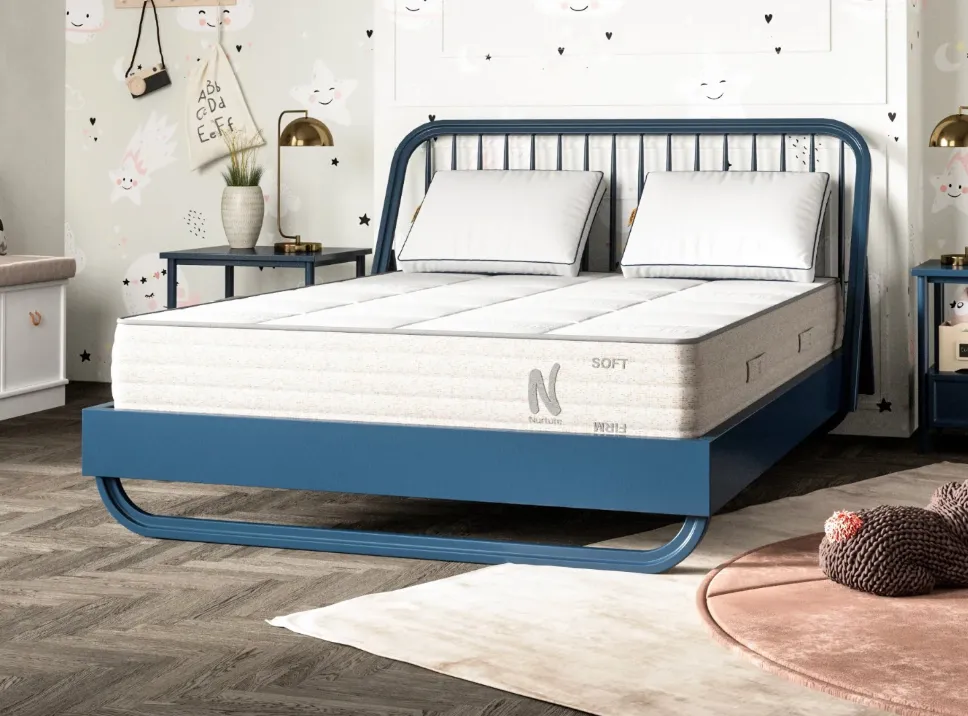
The Nolah Nurture earns Best Luxury thanks to its higher-end natural materials, refined dual-sided construction, and durable build meant to span years. It’s a good match for families who want a do-it-all bed that lasts well past the early years — the kind of purchase you make once and don’t revisit. While the mattress is on the expensive side, its price buys genuine longevity and material quality.

The Nurture is built from organic cotton, natural wool, and natural latex, with a flippable design offering two firmness feels to match your child’s growth stage. The natural latex gives it a resilient, supportive feel that distributes pressure evenly — the factor that matters most for growing bodies — while the sturdy support system supports healthy alignment and comfort. GREENGUARD Gold certification means the materials are screened for low chemical emissions, which speaks directly to the concern that new children’s mattresses may contain phthalates and synthetic flame barriers. The wool and latex breathe well, so the bed sleeps cooler than foam alternatives, and the cover is made of soft organic cotton.

The Nolah Nurture qualifies for free ground delivery throughout the contiguous U.S. The mattress ships directly to your doorstep and expands within a few hours after you remove it from its box. The sleep trial runs for 120 nights, and your purchase is covered under a lifetime warranty.

The Bottom Line.

The Nolah Nurture combines premium natural materials, a flippable design, and a lifetime warranty, making it the choice for families investing in a bed built to last.

  • Eco-conscious parents hoping to buy their child a mattress made from natural and organic materials.
  • Younger children transitioning to a big kid mattress who aren’t sure which firmness feels best.
  • Kids who run warm and need a cooling mattress to sleep comfortably.

Not recommended for:

  • Parents with tight budgets who want to limit their spending.
  • Kids who prefer plush beds with close hugging and little to no bounce.

Best for Teens Helix Midnight

Best for Teens –  Helix Midnight

Highlights

  • Medium Firm (6)
  • 120-night sleep trial
  • Lifetime warranty
  • Memory foam hugs the body
  • Reinforced perimeter coils protect the edges from compression
Up to 30% off
Get Discount

Best for Teens Helix Midnight

helixsleep.com

Shop Now

The Helix Midnight earns Best for Teens because it’s a genuine adult mattress with a versatile design that’s suitable for any tween or teen who has outgrown a kid-specific bed. Its medium firm (6) feel accommodates a wide range of sleep positions and body sizes, and it’s built to carry a young sleeper into adulthood rather than needing replacement in a few years. This is the bridge between a kids’ bed and a grown-up one.

The Midnight is a hybrid, pairing a supportive coil core with foam comfort layers for a soothing mix of contouring and responsiveness. This balanced feel is its defining trait, and what makes the mattress a solid match for side and back sleepers across most weight groups. The coils promote airflow with extra perimeter reinforcement to ensure solid edge support, while the foam layers hug the body and ease pressure at the shoulders and hips.

The Helix Midnight may cost more than dedicated kids’ mattresses, but its sticker price falls well below average for other memory foam hybrids on the market. Customers in the contiguous U.S. also enjoy free ground shipping. The mattress is backed by a 120-night sleep trial and lifetime warranty against manufacturing defects.

The Bottom Line.

The Helix Midnight is a versatile, adult-scale hybrid mattress that carries a teen into adulthood, making it the right upgrade once a kids’ bed no longer fits.

  • Tweens and teens who need a grown-up mattress.
  • Older children who have outgrown a kids’ bed and its smaller scale.
  • Budget-flexible parents who don’t mind spending a bit more on a long-lasting mattress for their child.

Cons

  • Young children transitioning from a crib or toddler bed who need a dedicated kids’ mattress.
  • Children with bunk beds who require a low-profile mattress for safety reasons.

Best Cooling Leesa Studio

Best Cooling –  Leesa Studio

Highlights

  • Medium Firm (6)
  • 120-night sleep trial
  • Lifetime warranty
  • Breathable cover with cooling comfort layers
  • Budget-friendly pricing
Up to 30% off
Get Discount

Best Cooling Leesa Studio

leesa.com

Shop Now

The Leesa Studio earns Best Cooling for its focus on breathability and temperature regulation — a real priority for kids who sleep hot and kick off their covers during the night. It’s a good match for children of any age, and especially for the ones who wake up sweaty on warmer beds.

The Studio combines a breathable cover with comfort layers designed to move heat away from the body, landing on a medium firm (6) feel that supports growing bodies. This cooling emphasis matters more for kids than many parents realize. Children have immature thermoregulation and sleep with a large share of their body surface in contact with the mattress, so a breathable, temperature-regulating surface can have a meaningful effect on sleep quality. The materials carry safety certifications, and motion isolation is reasonable for shared rooms. The trade-off is that a bed built to sleep cool won’t wrap a child in the warm, cocooning feel that some young kids prefer.

The Leesa Studio carries an accessible price-point and standard shipping is free for orders to all 50 states. The mattress comes with a 120-night sleep trial, and is further covered under a lifetime warranty against structural and material defects.

The Bottom Line.

The Leesa Studio prioritizes breathability and temperature regulation, making it the top pick for kids who sleep hot and need a cooler surface.

  • Kids who sleep hot and overheat on other beds
  • Warm-climate households where cooling matters year-round.
  • Budget-conscious parents hoping to spend less on their purchase without sacrificing quality.

Cons

  • Cold sleepers who like a warm, cocooning feel at night.
  • Children who want a responsive bed that feels springy when they move.

Mattress Buying Guide for Kids

Below, we share everything parents need to consider when buying a mattress for their child, along with our best tips for buying a new mattress.

What Parents Need to Know About Buying a Child’s Mattress

Healthy sleep is essential for growing children. The right mattress will provide a comfortable, supportive sleep surface for boys and girls throughout their childhood, and may even be able to accommodate them after they experience major growth spurts. The wrong mattress, on the other hand, can negatively affect a child’s sleep quality, creating far-reaching repercussions for their health, growth, and development.

This guide will look at mattress options for children who are old enough to sleep in their own bed, as well as some shopping tips for parents. Please note that this page will focus on mattresses that may be used by adults or children, not mattresses that are specifically designed for kids’ beds. While many mattress manufacturers offer beds that are specifically designed for children, parents often find that a non-specialty mattress is just as suitable for their child’s sleep needs and preferences.

Support is arguably the most important factor to consider when shopping for a child’s mattress. In the mattress industry, ‘support’ refers to how well a mattress maintains a flat, even sleep surface and promotes spinal alignment. Growing children need optimal support, particularly around their spine, and parents are strongly urged to select models that will provide adequate support.

Mattresses that are too firm or too soft are generally considered unsupportive for most sleepers. Additionally, some mattresses may begin to sag in the middle after as little as one to two years of use; this causes children to sleep in positions that do not align the spine.

Finding the most supportive mattress for your child is a combination of several factors, including the mattress size, firmness, material composition, and more. We’ll review each of these features in the following sections.

Selecting the Right Mattress Size for Your Child

When choosing a mattress for your child, it’s important to keep in mind that they will probably grow by a significant margin before the mattress needs to be replaced. As a result, parents may want to consider larger sizes to ensure their boy or girl won’t outgrow their bed.

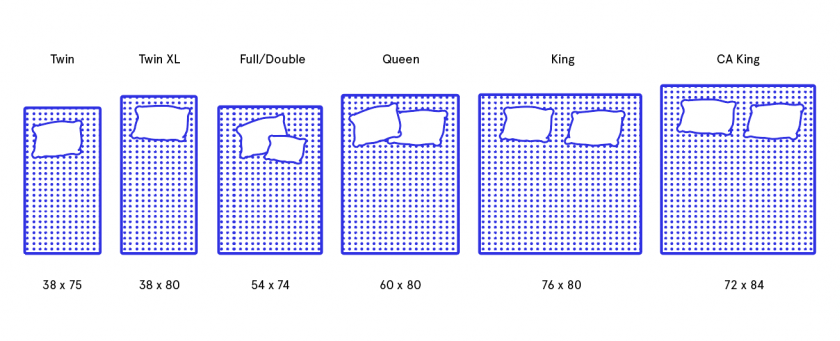
Most mattresses sold today come in six standard mattress sizes.

mattress sizes

Size Dimensions (width/length) Suitable for kids?
Twin 38W” x 75L” Yes. Although this is the smallest mattress size available, these sizes measure more than six feet in length, making them suitable for most children. This is also usually the cheapest size.
Twin Extra Long (XL) 38W” x 80L” Yes. The extra five inches of length over a standard Twin may be helpful for teenagers that are somewhat tall and expected to grow more.
Full or Double 54W” x 75L” Yes. Full/Double mattresses are often ideal for children because they are wide enough to accommodate restless sleepers and long enough for any child who is less than six feet tall. Many children are able to sleep on their Full/Double mattress until they reach adulthood.
Queen 60W” x 80L” No. Queen-size mattresses measure six feet wide and nearly eight feet long, making them excessively large for most children. Parents can usually save some money by opting for a Full/Double instead, which offers adequate room at a lower price-point.
King 76W” x 80L” No. A King-size mattress is simply too large for most children and will be an expensive investment for parents.
California King 72W” x 84L” No. Like King-size mattresses, the California King is too large and expensive to be suitable for a child’s bed.

As you can see, the most popular mattress sizes for children are Twin, Twin XL, and Full (or Double). Here’s a quick list of the pros and cons of each of these three mattress sizes for parents to consider.

Twin Mattresses

  • Twin mattresses are the smallest and cheapest mattress size available today.
  • These can be a great choice if space is a consideration, such as when your child has a smaller bedroom, shares their bedroom with another sibling, or uses a bunk bed.

Cons

  • Twin mattresses are the easiest to grow out of, especially if you expect your child to be an athlete or grow over six feet tall.
  • While your child is still little, Twin mattresses can feel a bit cramped if you’re lying in bed with your child to read a story together or to help them fall asleep.

Twin XL Mattresses

  • These include an additional six inches in length over Twin mattresses, making them an ideal option for teenagers or children of tall parents.
  • Twin XL mattresses are still relatively cheap.

Cons

  • The longer size of a Twin XL may not always fit in bunk beds.
  • These mattresses can still feel cramped if you’re lying in bed with your child to read a story together or to help them fall asleep.

Full/Double Mattresses

  • Full mattresses wide enough to accommodate larger children, kids who want to sleep with you, or those who like you to read to them before they go to sleep.
  • They can also be suitably comfortable for children to sleep on once they become adults, and come to visit you at home.
  • Full-size mattress can double as a guest bed much more easily than smaller sizes.

Cons

  • Full mattresses are the most expensive of these three mattress sizes, but they can be a good financial investment, since they provide ample room for your child to grow.
  • If your child’s bedroom is small, however, they can be a tight fit.

Selecting the Right Mattress Firmness Level for Your Child

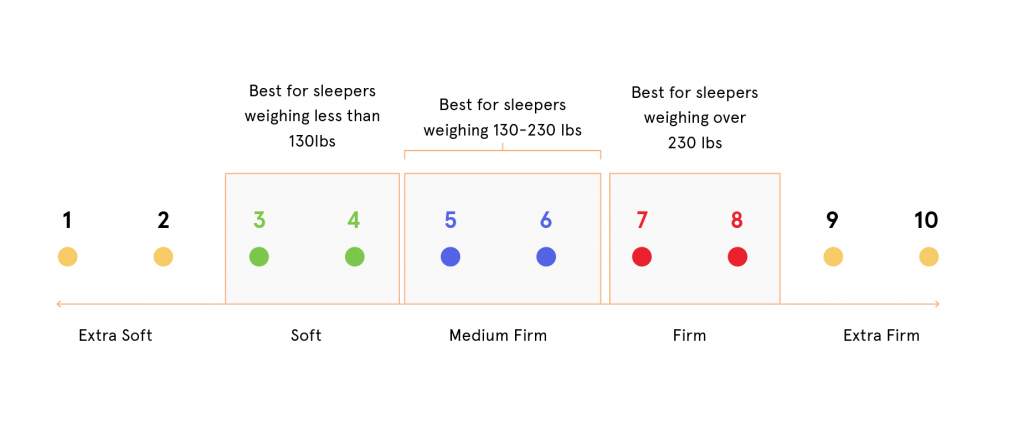
Mattresses sold today are available in a wide range of firmness options, from very soft to very firm and everything in between. At Tuck, we refer to firmness as having a 1 to 10 scale, with ‘Soft’ mattresses rating around a 3, and ‘Very Firm’ mattresses rating around an 8.

Although a ‘Medium Firm’ design is generally considered the most popular, that’s usually assuming the sleeper is an adult of average weight (between 130 and 230 pounds). Every child will have different firmness preferences, and they’ll typically find a softer mattress to be more comfortable when they’re younger and still growing.

However, you can always buy a ‘Medium’ or ‘Medium Firm’ mattress and then get a mattress topper with a softer firmness rating to make the mattress more comfortable for your child until they grow into it. Jump to learn more about mattress toppers.

Alternately, you can select a mattress firmness according to your child’s body weight and preferred sleep position. It’s important to note that children who weigh less than 130 pounds tend to feel most comfortable on mattresses that are ‘Soft’ to ‘Medium’, while heavier children typically prefer mattresses that are ‘Medium’ to ‘Firm’.

Regarding sleep position, side sleepers find softer mattresses to be more comfortable, between ‘Soft’ and ‘Medium Firm’, or a 3 to 6 on the 1-to-10 scale. A softer mattress surface allows wider and heavier parts of the body to sink deeper into the mattress, ensuring healthy spinal alignment for the side sleeping position. Stomach sleepers typically prefer firmer mattress surfaces, to avoid their pelvis from sinking too deeply and pulling the spinal alignment. Back sleepers make things easy, as they usually enjoy the widely popular ‘Medium Firm’ setting.

Parents should have their child test out different mattress firmness options in order to determine the best comfort level for them. You can do this easily at your local mattress retailer. Have your child lie on the bed in store and tell you how comfortable they feel. Of course, you can return a mattress under the sleep trial if it ends up being too soft or too firm, but the easier approach is to know your child’s preferred firmness level before buying the mattress.

A note on flippable mattress designs: If a child tends to change his or her mind about their desired firmness option, then a flippable mattress may be a reasonable investment. These beds are designed with a comfort layer on each side with a different firmness and a shared support core. To adjust the firmness from one to the other, simply flip over the mattress. Please note: parents should handle the flipping process, as mattresses are always too heavy for children to lift.

Understanding the Different Mattress Types

Mattress type is an important consideration, since each different design carries unique pros, cons, and precautions for parents. Below we provide an overview of the five most common mattress types and share everything you need to know:

Innerspring Mattresses

Innerspring beds use steel springs in their support core, laid in a uniform grid. Comfort layers are made of polyfoam or memory foam.

Benefits for Kids and Parents:

  • Low price-point. Innerspring mattresses are one of the most affordable mattress types, usually costing around $700 to $1,200.
  • Sleeps cool. The coil support core provides ample airflow, and thinner comfort layers minimize the potential for heat retention.
  • Good option for growing children. Innerspring mattresses have a traditional feel that’s comfortable for many sleepers, and their steel support system supports the weight of growing bodies.

Disadvantages for Kids and Parents:

  • Noise potential. Because they use steel springs as their support system, these beds can be noisy when bearing weight.
  • Limited durability. Depending on the quality of their construction, innerspring beds can be prone to sag within a handful of years.
  • Too firm for some children. Thinner comfort layers may not provide enough cushion for smaller or more lightweight children.

Precautions for Parents:

  • Bounce potential. Innerspring beds are definitely the bounciest, which can be problematic if your child is prone to jumping on the bed.

Foam Mattresses

Foam mattresses use foam in all layers of the mattress, with memory foam and/or polyfoam in the comfort layer and high-density polyfoam in the support layer.

Benefits for Kids and Parents:

  • Low price-point. Foam mattresses are generally more affordable, costing around $600 to $1,200.
  • No noise. Foam absorbs movement and related noise extremely well, so these beds sleep silent even if your child shifts positions often during the night.
  • Good motion isolation. Along the same lines, the all-foam construction isolates motion, which can make these beds a great option for kids who share a bed or light sleepers.
  • Long lifespan. Quality foam mattresses can last up to 7 years or longer.
  • Excellent pressure relief. The high conforming ability of these mattresses makes them especially suitable for children with growing pains.
  • Anti-bounce. Foam mattresses are made entirely of foam, reducing the fun (and injury risk) of jumping on the bed.

Disadvantages for Kids and Parents:

  • Off-gassing potential. Memory foam mattresses have an initial off-gassing odor. This dissipates fairly quickly (within a few days) once the beds are unwrapped and set up, but may be a bit much for sensitive noses to take.
  • Can sleep hot. Foam mattresses conform closely to the body, which can result in a warmer sleep experience.

Precautions for Parents:

  • Look for certified foams. CertiPUR-US foams have been tested for safety, indoor air quality, and low VOC emissions. Certified foams tend to sleep cooler and produce less odor.

Hybrid Mattresses

Hybrid mattresses use individually pocketed coils as their support system, with at least 2 inches of memory foam or latex in the comfort layers. These beds may feature additional foams or minicoils in the comfort layers, too.

Benefits for Kids and Parents:

  • Long lifespan. Hybrid mattresses remain supportive for up to 7 years or more.
  • Contoured support ideal for growing pains. With thick comfort layers above a pocketed coil core, hybrid mattresses offer a higher level of contouring than innerspring mattresses, but without enveloping the body like memory foam.
  • Quieter sleep surface. While not as quiet as all-foam beds, hybrid mattresses do minimize movement and noise well, resulting in a quiet sleep surface for more restless sleepers.
  • Sleep cooler than all-foam beds. Depending on the composition of their comfort layers, hybrid beds tend to sleep cooler thanks to air flowing through the pocketed coil core.

Disadvantages for Kids and Parents:

  • Higher price-point. Hybrids do tend to be more expensive, costing around $1,500 to $2,200.
  • Heavy and difficult to move. Hybrid mattresses feature a heavier construction that can make it tougher for children to make their bed.
  • Noise potential. If the hybrid has thinner comfort layers, it may not isolate movement as well. The resulting noise may wake up light sleepers or children who share the bed with a sibling.

Precautions for Parents:

  • Pay attention to the foam materials. If your child is a hot sleeper, look for hybrid mattresses with cooler comfort layers. These include latex foams, or memory foam infused with gel, graphite, or copper.
  • Off-gassing potential. If the bed has thicker comfort layers of memory foam or polyfoam, there may be an initial off-gassing odor present for the first few days.
  • Bounce potential. While not as bouncy as innerspring mattresses, kids may still find these beds bouncy enough for jumping on the bed.

Latex Mattresses

Latex mattresses use polyfoam or latex in the support core, with comfort layers of latex. Latex mattresses may use only natural latex, synthetic latex, or a blend of the two. Natural latex tends to be more durable and sleep cooler, although it’s also more expensive.

Additionally, the latex may be poured using either the Talalay or Dunlop process. Talalay latex has a fluffier feel more suitable for comfort layers, while denser Dunlop latex may appear in either the comfort or support layers of the mattress.

Benefits for Kids and Parents:

  • Good motion isolation. Latex mattresses absorb motion well, resulting in a quieter, more still sleep surface for kids who share the bed.
  • Long lifespan. Latex mattresses are extremely durable, especially if they use primarily organic latex foams. These beds should last over 8 years or more.
  • Naturally hypoallergenic. As long as your child doesn’t have a latex allergy, these beds can be particularly great for kids with asthma or allergies. Organic latex is naturally resistant to mold, bacteria, and other allergens that can make breathing tougher for kids at night.
  • Sleep cool. Latex mattresses sleep cooler than hybrid or foam beds, as organic latex is naturally more breathable. It’s common for all-latex beds to use cotton and wool in their cover, which further helps regulate the mattress surface temperature.
  • Anti-bounce. Latex mattresses don’t contain any spring components, so children will be less likely to engage in jumping on the bed.

Disadvantages for Kids and Parents:

  • High price-point. Latex mattresses, especially ones made from natural latex, are more expensive, costing around $1,500 to $2,500.
  • Less pressure relief. Latex mattresses do not conform closely to the body, so they may offer less pressure relief for children experiencing growing pains.

Precautions for Parents:

  • Allergy potential in organic latex beds. If your child has an allergy to latex, these beds will not be a good fit. Although, synthetic or blended latex foams may carry a lower allergy risk.

Airbeds

Airbeds use air as their support system, with individual air chambers that can be adjusted according to the owner’s firmness preferences. Airbeds may have a thin, foam-based comfort layer, or feature no comfort layer at all.

Benefits for Kids and Parents:

  • Adjustable firmness. Since the firmness can be adjusted at any time, airbeds can be a good choice for children who are still growing or have changing firmness preferences.
  • Long lifespan. As long as they are properly maintained and individual parts are replaced as needed, airbeds can easily outlast other mattress types.

Disadvantages for Kids and Parents:

  • High price-point. Airbeds are one of the most expensive mattress types, costing around $1,500 to $2,500.
  • Controls may be difficult for kids to operate. You need to use a manual hand crank or remote control to adjust the firmness level, which can be confusing for children.
  • Below-average pressure relief. Because the comfort layers are so thin, airbeds may not provide sufficient pressure relief for kids experiencing growing pains.

Precautions for Parents:

  • Electrical components carry a high safety risk. Airbeds often feature electrical components which may make them dangerous for children to operate.

The chart below summarizes the key advantages and disadvantages of these mattress types for kids:

Mattress Type Benefits for Kids and Parents Disadvantages for Kids and Parents Precautions for Parents
Innerspring Low price-point
Sleeps cool
Good option for growing children
Noise potential
Limited durability
Too firm for some children
Bounce potential
Polyfoam/Memory Foam No noise
Long lifespan
Good motion isolation for kids who share a bed
Off-gassing potential
Sleeps hot
Certified foams produce less odor and sleep cooler
Latex No noise
Good motion isolation for kids who share a bed
High price-point
Allergy potential in organic latex beds
Synthetic or blended latex carries lower allergy risk
Hybrid Long lifespan
Contoured support
High price-point
Noise potential
Bounce potential
Airbed Adjustable firmness
Long lifespan
High price-point
Noise potential
Electrical components
Controls may be difficult for kids to operate
Electrical components carry high safety risk

Other Mattress Questions for Parents to Consider

By now you know the size, firmness, and type of mattress you want to buy for your child. You’re ready to go mattress shopping. If you find yourself torn between a few different models, ask yourself the following questions to find the best mattress for your child’s needs.

  • How Important Is Durability?

    Durability is key for selecting a child’s mattress because there is a strong chance he or she will grow significantly during the bed’s lifespan. As such, parents may not want to invest in a long-lasting, potentially more expensive mattress (such as a latex or airbed model), and may opt for a cheaper, less durable model instead (such as an innerspring or memory foam mattress). However, models that are prone to early sagging may not be a good choice, since sagging can impact the supportiveness of a mattress.

  • Is Your Child a Hot Sleeper?

    Sleeping hot is most commonly associated with memory foam and polyfoam beds, although hybrids and innersprings with thick foam layers may also feel warm. Temperature neutrality is important for all sleepers including children, particularly those who tend to sleep hot regardless of the mattress they use. If the mattress has thicker comfort layers, look for cooling materials like gel, copper, or graphite (like the T&N Mattress uses).

  • Do You Want a Low- or High-Profile Bed?

    Thickness preferences will depend on the child, but smaller children typically prefer mattresses that are 12 inches or shorter in height. These models are usually easier for smaller bodies to get on and off of, compared to higher-profile beds. Most kids 10 or older won’t have as much difficulty climbing into or out of higher-profile mattresses.

  • Is Your Child Sensitive to Smell?

    Off-gassing odor is to be expected from most mattresses when they are new, but foam-based models (as well as some latex and hybrid designs) may produce smells for days or weeks afterward. This may be a problem for children who are sensitive to smell.

  • Does Your Child Share Their Bed or Bedroom With a Sibling?

    Some mattresses are designed to absorb and minimize motion transfer, which occurs when someone shifts positions or gets in and out of bed. These models can be helpful for beds that accommodate more than one child.

    Innersprings and hybrids may produce squeaking sounds due to their metal components, and airbeds feature electrical systems that may be somewhat loud. If a child is sensitive to noise, then a foam or latex model may be best.

  • How Old Is Your Child?

    Most girls experience major growth spurts between the ages of 8 and 13 years, while most boys experience growth spurts between the ages of 10 and 15. If a child is nearing an age where significant growth is expected, then a longer mattress may be more suitable, such as a Twin XL or Full.

    Alternatively, parents may opt for a cheaper mattress that fits their current size, and plan to replace it when the growth spurt begins to take effect — though this may not be suitable for parents on a budget.

  • What’s Your Child’s Preferred Sleep Position?

    Children who sleep on their backs will be less restricted when it comes to choosing a mattress type and firmness. For children who sleep on their side, a relatively soft mattress will usually be best; firmer models do not sink deeply enough to help align their spine. For stomach sleepers, a soft to medium mattress may be best — although stomach sleeping is generally discouraged due to the excessive pressure this position puts on the body.

  • Does Your Child Like to Jump on the Bed?

    Parents who are worried about their child bouncing on their mattress (and potentially hurting themselves) may want to choose a mattress made of foam and/or latex with no spring components and soft to medium firmness. These mattresses are not very responsive, and offer little to no bounce, which can reduce the risk of the child getting hurt.

How to Review Sleep Trial & Warranty Periods

Lastly, let’s look at two other important aspects of buying a new mattress: the sleep trial and warranty coverage.

Sleep Trial

For parents who are unsure which mattress will work best for their children, a sleep trial can make a huge difference. Most mattress brands and retailers offer sleep trials that allow customers to test out the mattress for a certain length of time (anywhere from 90 to 365 nights), and then return it for a full or partial refund if they are dissatisfied.

All of the mattresses we’ve reviewed above have sleep trials lasting 100 nights or more, with the Nectar offering a full 365 nights.

Make sure you understand the terms of the sleep trial. Some brands will require you to test the mattress for a “break-in” period (usually 30 to 60 nights) before you can return it for a refund.

Mattress Warranty

Children can be hard on a mattress for a number of reasons, and some wear and tear is expected. The mattress warranty will not usually cover defects that stem from normal wear and tear, but they will cover certain defects, such as significant sagging or indentations in the sleep surface that affect support or manufacturing flaws in the mattress or mattress cover.

The warranty coverage periods are key. Some mattress warranties are entirely nonprorated, which means the company will repair or replace defective mattresses at no extra expense to the owner (except for shipping and handling fees in some instances). Other warranties are partially prorated, which means owners must pay a certain percentage of the original mattress price in order to have it repaired or replaced. This can add up to major expenses. As a general rule, parents should not select a mattress that offers less than two years of nonprorated coverage.

Pay particular attention to what the warranty says about the bed’s foundation. You can void a mattress warranty if you don’t use the proper foundation for the bed, whether that’s a solid foundation, the floor, or a bed frame. If your child sleeps on a bunk bed or uses a less-common foundation, make sure it’s covered under the warranty.

Pillows & Sleep Accessories for Kids

In addition to their mattress, parents should carefully choose other components of their child’s sleeping area to ensure they get high-quality rest night after night. Let’s look at some strategies for selecting pillows, mattress toppers, and bunk beds for kids.

Pillows for Kids

Pillows, like mattresses, are designed to support sleepers by providing an even surface — in this case, for the head, neck, and shoulders. The most important consideration when shopping for pillows is ‘loft,’ or thickness. Pillows that are too thin or too thick provide do not properly align the spine, which can lead to discomfort and pressure.

When determining the proper loft for your child’s pillow, it’s important to keep the following factors in mind:

  • Head size: Children with larger-than-average heads typically feel most comfortable on high-loft pillows that provide sufficient support, while those with smaller-than-average heads tend to feel comfortable on low-loft pillows.
  • Body weight: Children who weigh more require less loft, and will usually feel most comfortable on thinner pillows, while those who weigh less may require extra loft in order to feel supported and comfortable.
  • Shoulder width: As a general rule, children with broad shoulders usually prefer high-loft pillows and children with narrower shoulders usually prefer low-loft pillows.
  • Mattress firmness preference: Low-loft pillows tend to be better for those who prefer softer mattresses; this is because the pillow provides less of a barrier between the sleeper’s body and the mattress surface. In contrast, high-loft pillows may be better for those who prefer a firmer mattress surface because the sleeper does not need to sink as deeply.

The table below breaks pillows down by three loft categories:

Loft Thickness Optimal Head Size Optimal Weight Optimal Shoulder Width Optimal Mattress Firmness
Low Less than 3″ Small More than 200 lbs. Narrow Soft to Medium Soft
Medium 3″ to 5″ Average 100 to 200 lbs. Average Medium
High More than 5″ Large Less than 100 lbs. Broad Medium Firm to Firm

Pillow composition is another key factor. Some pillow materials are associated with high levels of support, including buckwheat, latex, and memory foam. Latex and buckwheat pillows are also considered more durable than other pillow types. However, these two pillow types tend to be somewhat expensive. In contrast, cheaper pillow types — such as down alternative and polyester models — do not provide the same levels of support, and tend to wear out much more quickly.

For more information, please check out our Best Pillows — Buying Guide and Information page.

Mattress Toppers for Kids

The term ‘mattress topper’ refers to an individual cushioning layer that is placed on the top surface of a mattress to adjust the firmness and comfort levels, and also provide better support in some cases. Mattress toppers may rest freely on the mattress, or may feature elasticized corners that can be tucked over the mattress like a fitted sheet.

In most cases, the topper is designed to make the sleep surface less firm; however, some toppers can increase the firmness when used on exceptionally soft mattresses. Either way, a mattress topper can be used to help a child sleep better on their current mattress’s firmness, if buying a new mattress is not financially feasible.

Toppers made of latex, memory foam, and wool are generally considered the best choice for kids. These models are fairly durable, less lumpy, and produce little to no noise. They are also among the most expensive topper options. More affordable toppers, such as those made from feathers and polyester fibers, are more affordable, but they also wear out more quickly, develop lumps and can be somewhat loud.

For more information about mattress toppers, please visit our Best Mattress Toppers guide.

Mattress Protectors for Kids

Moisture can seriously diminish the lifespan of a mattress, and introduce mold and bacteria into your child’s bedroom environment if not taken care of. Although some mattresses come with a removable, machine-washable cover, most mattresses are spot-clean only. So, if your child is prone to bedwetting, you may want to invest in some additional protection for your mattress.

Fortunately, it’s easy enough to protect your mattress investment and keep it clean with waterproof mattress protectors. Waterproof mattress protectors come in a few different styles. For children, fitted sheets, fitted pads, or six-sided protectors are all good options. These completely cover the top and sides of the bed and fit snugly, so the bed won’t look noticeably different or cause your child to feel embarrassed.

For more information, take a look at our reviews of the Best Mattress Protectors for Bedwetting.

Bunk Beds

Bunk beds is a catch-all term for any stackable bed that accommodates two or more sleep surfaces. They are typically made from wood or metal, and come equipped with ladders or stairs that can be used to access the top bunk(s). Some models also feature storage drawers in the base. The most common sizes for bunk bed mattresses are Twin and Full.

Bunk beds do carry a risk of injury. Sturdy construction is essential, and most models feature bars or other types of barriers to prevent sleepers from rolling off the top bunk(s). Parents should carefully research the product history and manufacturer warnings for different bunk bed models.

Additionally, purchasers should measure the height of their children’s bedroom before investing in a bunk bed; otherwise they may face space issues. In terms of price, metal bunk beds tend to be less expensive than wood models.

For more information, please check out our Best Bunk Beds guide.

Table of Contents